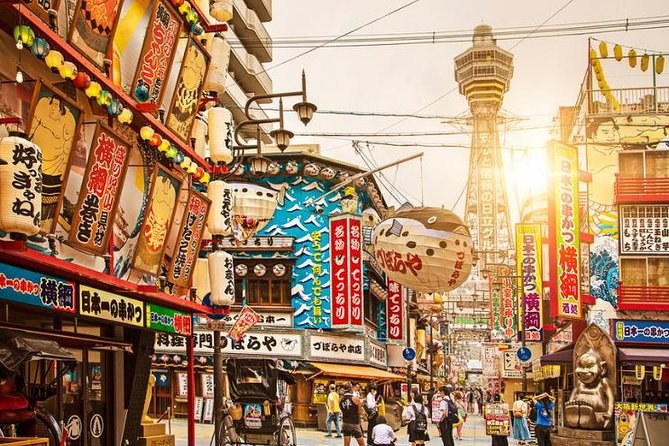
Osaka Food Tour: 15 Delicious Dishes & 3 drinks at 5 Eateries
Food includedDrinks includedLive English guide
From $69 per person
Two separate questions get muddled here: which month to come, and how far ahead to book. They have different answers, and both matter more in this city than they look. None lists the evenings themselves.
October and November, then April and May. Those four are dry, comfortable to walk in for three hours, and free of the two things that actually degrade an evening here: the June rain and the August humidity.
Autumn has one advantage over spring that nobody mentions. Sunset in late October is 17:24 and in November 16:54, so a six o’clock departure is fully dark from the first minute. In late April it is 18:42, and the first hour is daylight.
More than the weather does. Sunset moves from 16:47 in early December to 19:15 at the end of June — two hours and twenty-eight minutes — and departure times barely move at all.
Sunset published by the National Astronomical Observatory of Japan for Osaka, 2026.
| Month | Sunset | A 6pm departure is |
|---|---|---|
| January | 17:10 | dark from the start |
| February | 17:41 | dark from the start |
| March | 18:05 | dark by the second stop |
| April | 18:30 | dark by the second stop |
| May | 18:54 | daylight for an hour |
| June | 19:13 | daylight for an hour |
| July | 19:12 | daylight for an hour |
| August | 18:47 | daylight for an hour |
| September | 18:06 | dark by the second stop |
| October | 17:24 | dark from the start |
| November | 16:54 | dark from the start |
| December | 16:49 | dark from the start |
The practical move: in summer, book the latest departure the operator offers. In winter, take the earliest, because you get a full evening of lit streets and still finish well before the last train.
Further than you would guess. One operator publishes an average booking lead of 53 days on its busiest evening. Most departures cap at six, seven, eight or ten travellers, so a single family booking can take half a table.
Two to four weeks is a comfortable window for most of the year. For April, May, October and November, or for any Friday or Saturday, make it six.
Friday and Saturday fill first, then Thursday. Sunday through Wednesday are the easiest to get at short notice, and they have a real advantage: departures run smaller. More than one reviewer describes a weekday evening that ran with two guests.
The districts themselves are busiest on Friday and Saturday nights, which cuts both ways. Dotonbori at nine on a Saturday is the version you have seen photographs of. Uranamba on a Tuesday is the version the guides prefer.
Mid-June to mid-July, and it is less of a problem than it sounds. The rain is warm and comes in bursts rather than all evening, most of the walking is under arcades, and every meal is indoors.
Humidity is the real change. It makes three hours on your feet feel longer than the same walk in April, and it is why the summer months are worth planning around rather than avoiding.
After dark, no — but take it seriously. One operator’s own listing records Japanese summers reaching 40 °C and winters dropping to −5, and asks travellers to prepare accordingly. Another asks you to bring water and wear a hat.
Evenings are the sensible time to be outdoors in an Osaka August, and the air-conditioned rooms these tours use are part of the appeal rather than incidental. Book the latest departure and drink more water than you think you need.
| Period | What happens | Book? |
|---|---|---|
| Golden Week, late Apr to early May | Domestic crowds fill the districts | Yes, but weeks ahead |
| Obon, mid-August | Domestic travel peak, hot and humid | Later departures |
| 28 Dec – 1 Jan | Osaka Castle Main Tower closed, departures thin | Check availability first |
| Cherry blossom, late Mar to early Apr | Park crowds in the evening | Yes, book early |
| September typhoon days | Occasional weather cancellations | Yes — you are refunded in full |
You are refunded in full. Two operators reserve the right to cancel for genuinely bad weather — a typhoon in September rather than a shower in June — and the same 24-hour policy that covers a change of mind covers this.
Ordinary rain does not stop anything. If you are worried, book an evening that spends most of its time indoors: the food walks sit down three to five times.
Only around three fixed points, and they are worth knowing because they move crowds rather than prices. Golden Week, from the end of April into the first days of May, fills the districts with domestic visitors. Obon in mid-August does the same, in the year’s worst heat. And the New Year period thins departures out while Osaka Castle Main Tower closes entirely from 28 December to 1 January.
Cherry blossom is the fourth, and it is worth planning around rather than avoiding. For a week or two from late March, Osaka Castle Park in the evening is one of the better things in the city and it is free. The guided evenings do not go there, so do it before your departure rather than instead of it.
More than you would think, because a lot of what these evenings serve is seasonal by habit rather than by menu. Oden — a slow-simmered stew from a shared pot — is a winter counter dish and it is at its best from November to February. Cold beer and standing bars belong to July and August.
Kushikatsu, takoyaki and okonomiyaki run all year and are the backbone of every food evening whatever the month. What changes is the room: a counter in February is a warm place to be, and a counter in August is an air-conditioned one, and both are better than the street outside.
You will still find something, particularly midweek and outside the four peak months. The evenings most likely to have space are the two-hour Kyobashi bar evening, the ghost walk and the private walks, all of which are less booked than the food evenings.
Check availability rather than assuming: the caps are small, but so is the number of people booking a Tuesday in February. The FAQs cover cancellation and minimum numbers.
Departures cluster between 17:30 and 18:30, and most operators run one or two a night rather than a rolling schedule. Where there is a choice, the later slot is better in summer and the earlier one is better in winter, for the reason the sunset table makes obvious.
There is a second consideration in the food districts. A counter at six is quiet and a counter at eight is full, and full is more fun but slower. If you are travelling with anybody impatient, take the early slot.
Every three-hour evening here finishes in time for the last train regardless of which slot you take. Nothing listed finishes late enough to strand anybody.
If you have two evenings in the city, yes, and book them as a pair rather than separately. A food evening first gives you the districts, the dishes and enough vocabulary to be useful; a bar evening on the second night lands differently once you know what you are looking at.
Book them for consecutive nights rather than spread across a week, and put the food evening first. The reverse order works but wastes half of what the first night taught you.
If you have three evenings, add the northern pair — Tenma and Kyobashi — which almost no visitor reaches and which two operators sell explicitly as the version without Dotonbori in it.
The weather page has the month-by-month detail, and Osaka Night Tours lists every evening with its cap so you can see how much room there is.
From $69 per person
From $110 per person
From $112 per person