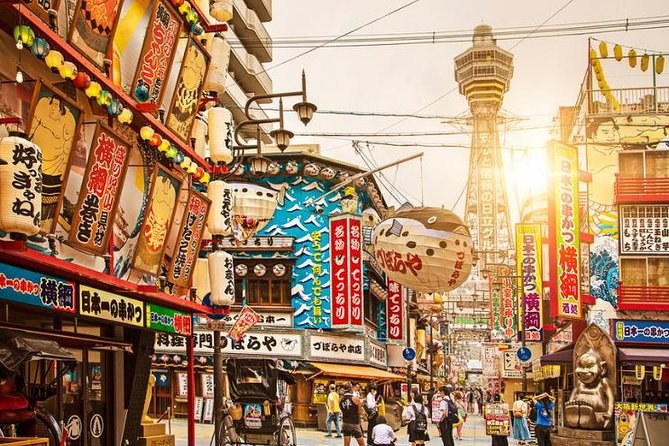
Osaka Food Tour: 15 Delicious Dishes & 3 drinks at 5 Eateries
Food includedDrinks includedLive English guide
From $69 per person
There are thirteen guided evenings to choose from in this city and they look more alike on a listings page than they are. This guide sorts them on the five things that actually differ, so you can stop comparing photographs. Osaka city night tour has all of them with their prices.
Does the fare buy your dinner, or does it buy you a guide? Everything else follows.
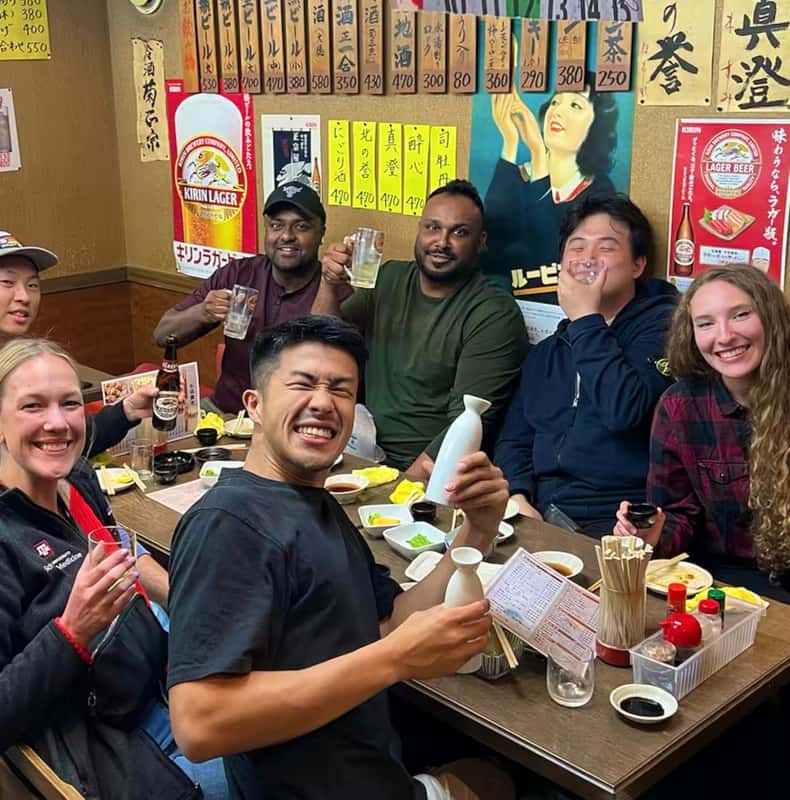
On a food evening you pay once, sit down three to five times, and finish having spent nothing more. On a bar evening you pay a smaller ticket, then settle the counters yourself in cash — about 7,000 yen on one, 8,000 to 10,000 on another, both figures the operators publish themselves. The totals end up close. What differs is the shape of the night.
Six, and each one is a different evening rather than a different price point.
Ticket prices are the operators' own, captured 2026-09-03. The cash column is the figure two of them publish for their counters.
| Format | Ticket | Cash on the night | Realistic total |
|---|---|---|---|
| Bar crawl, guide-only | $30–$44 | 7,000–10,000 yen | About $80–$110 |
| Food walk | $69–$112 | Nothing, or one extra drink | $69–$115 |
| Backstreet evening | $106 | Extra drinks only | About $110 |
| Market and canal walk | $99 | Anything beyond the tastings | About $100 |
| Themed walk | $43 | Dinner and train fare | About $65 |
| Private evening | $83–$136 | Food and tickets | $110–$180 |
The number that surprises people is the bottom-left one. A cheap ticket plus a real bar bill is not a cheap evening, and the guide-only formats are honest about that in a way most listings are not.
This is the second axis, and on some nights it matters more than the format. Caps here run from six to sixteen, with one departure publishing a maximum of a hundred travellers. A table of six is a conversation; a group of sixteen is a walking tour that stops to eat.
Neither is wrong. Both have warm reviews. But the words “small group” appear in product names that cap at six and in product names that cap at a hundred, so read the number rather than the adjective.
Not necessarily, and this catches groups more than anything else. Japan’s legal drinking age is 20, and every bar-led evening here sets its floor there. The ghost walk asks 16 and over for its subject matter. The food walks take 13 or 16 and up, and one welcomes all ages with infant seats available.
If anybody in your party is under twenty, the decision is already made: it is a food evening. Things to do sets out which ones work with children.
The district changes the night more than the operator does. Dotonbori and Namba are the neon you have seen pictures of. Shinsekai is kushikatsu and Tsutenkaku. Uranamba is the bars behind the arcades. Tenma and Kyobashi are the after-work districts almost no visitor reaches.
| District | What the evening feels like | Formats that go there |
|---|---|---|
| Dotonbori / Namba | Busy, bright, the classic dishes | Food walks, bar crawls, the backstreet evening |
| Shinsekai | Louder signage, cheaper counters, kushikatsu | Two food walks, one private walk |
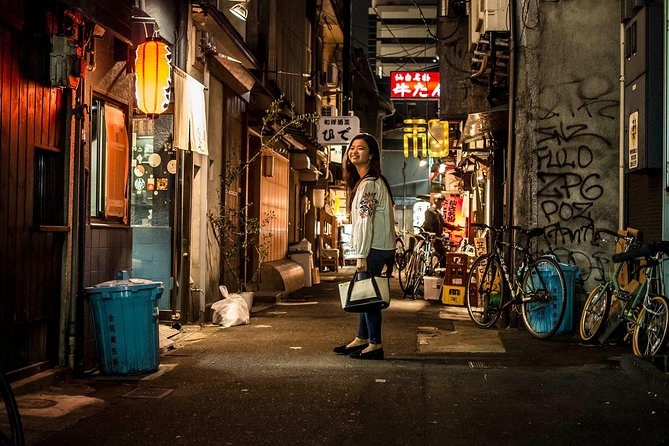
| Uranamba | Small rooms, no signage, cash only | Bar crawls |
| Tenma / Kyobashi | After-work, no visitors, standing bars | Two food evenings, one bar evening |
| Osaka Castle Park | Floodlit, free, quiet | The ghost walk |
Raise them when you book, not on the night. One operator states that vegan and gluten-free cannot be accommodated at all. Another asks for at least a day’s notice and warns that the kitchens are not its own. A third fed a vegetarian couple well, with vegetable kushikatsu and mochi in place of the takoyaki.
More than one operator refuses requests made on the day. If your requirement is firm, pick the evening that says it can handle it rather than hoping.
Sometimes not, and it is worth saying so. If what you want is the canal, the sign and a plate of takoyaki, walk from Namba Station and give it two hours. It costs nothing.
What a guide buys is the part that is hard alone: a seat at a counter that holds six people, an order placed in Japanese, and the bar behind a door with nothing written on it. If that is what you are after, book one. Doing it alone is a guide of its own, and it makes that case properly.
This is the question nobody asks and everybody should. Review volume across these thirteen evenings runs from one review to more than three thousand, and a five-star average built on a single booking tells you almost nothing.
Four products here carry more than a thousand reviews each. Three carry between forty and five hundred. Six carry fewer than ten, and two of those carry exactly one. That is not a judgement on the tours — a new listing has to start somewhere — but it is a judgement on how much weight the rating can bear.
| Evidence | What it means | How many |
|---|---|---|
| 1,000+ reviews | The rating is stable and the format is proven | Four |
| 100–500 reviews | Solid, and enough to see a pattern in the criticism | Three |
| 40–99 reviews | Indicative, worth reading in full | One |
| Under 10 reviews | Treat the star score as provisional | Five |
If you want the safest booking, take one of the four with a thousand or more. If you want the cheapest, note that the cheapest evening here also has several hundred reviews behind it, which is an unusual combination.
They cluster in one place, and it is worth knowing where. Almost every low rating on these listings describes a gap between what a description promised and what the evening delivered — not bad food, not a bad guide, but a mismatch.
On the bar-led evenings the complaint is that there was more drinking than eating. On the food evenings it is occasionally that the food was ordinary for the price, or that a guide turned out not to be a local. On one, a reviewer found the meeting point named in the description no longer existed.
All of those are avoidable by reading the fare line rather than the marketing. If the Includes block does not say dinner, there is no dinner. The reviews page keeps the critical ones alongside the warm ones for exactly this reason.
If you want a shortcut, these are the three that between them answer most of what people ask for, and they are the three featured on the homepage.
Between them they cover three districts, three price bands, three formats and two platforms, which is why they are the three.
Weeks rather than days. One operator publishes an average booking lead of 53 days on its busiest evening, and most departures cap in single figures. Spring and autumn go first, and Friday and Saturday go before the rest of the week.
Everything here refunds in full at 24 hours’ notice and several let you reserve now and pay later, so booking early costs you a decision rather than money. The timing guide has the seasonal detail.
It happens constantly — one of you wants dinner and the other wants a bar. Three workable answers.
The first is the backstreet evening, which is genuinely both: ninety minutes over an izakaya dinner with the alcohol included, then introductions to bars. It is the only product here that does not make you choose.
The second is the Namba bar-hopping evening, which is sold as a bar tour and includes a full dinner of six or more tastings across three izakaya, capped at seven travellers. The third is to book two nights and do one of each, which is the best answer if you have the time.
Not to the evening, and slightly to the booking. Nine of these are listed on one platform and four on another, and in one case the same operator’s same evening appears on both at slightly different prices.
What differs is presentation rather than product: one platform publishes a star histogram you can check the total against, the other publishes per-criterion scores for the guide, transport and value. Both confirm at the time of booking and both refund in full at 24 hours. Book wherever the departure you want has space.
If you are still between two, the options page compares the formats on a fixed contract, and Osaka Night Tours lists every departure with its price and its meeting point.
From $69 per person
From $105 per person
From $30 per person