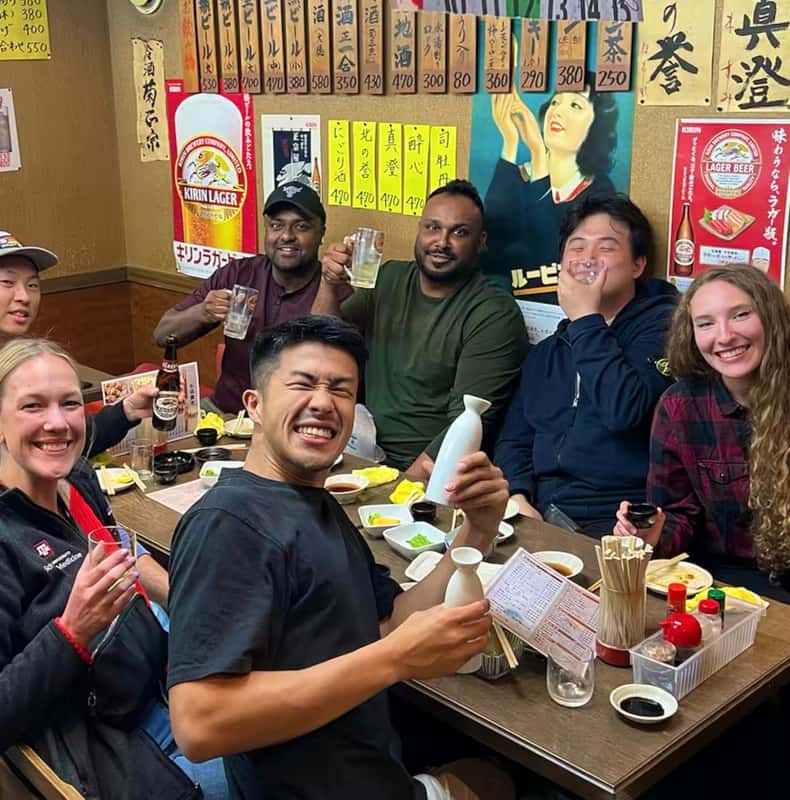
Osaka Dotombori Uranamba Local Bar & Izakaya Crawl Tour
Pay at the counterPhotos taken for youLive English guide
From $30 per person
Prices on a listings page are not comparable in this city, because two evenings at very different prices can cost the same by the end of the night. This guide sets out what each band actually buys. Osaka Night ticket prices shows the current figures.
Operators' own prices, per person, captured 2026-09-03.
| Band | Ticket | What it buys | Cash on the night |
|---|---|---|---|
| Entry | $30–$44 | A guide, the ordering, the introductions, the photographs | 7,000–10,000 yen |
| Themed | $43 | A drink, the stories, an hour in Osaka Castle Park | Dinner and train fare |
| Mid | $69–$100 | Dinner across three to five stops and the first drink at each | Very little |
| Upper | $105–$112 | Dinner, alcohol, and on two of them the train fare between districts | Extra drinks only |
| Private | $83–$136 | Your own party, a route agreed with the host | Food and tickets |
Because it is not selling you the same thing. A guide-only fare covers a person for three hours. A fare-inclusive one covers a person plus fifteen dishes, three drinks and sometimes a train ticket. The gap is the food, and the food is real.
Both are honest products. What is not honest is comparing the two numbers on a listings page as though they measured the same thing.
Two operators publish it, which is more than most manage. One puts the counter bill at about 7,000 yen a head, roughly 2,000 to 3,000 per venue, cash only, split evenly across the table. Another puts it at 8,000 to 10,000 yen for its three venues.
On a food evening the answer is close to nothing. Extra drinks beyond the one included at each stop run about 500 yen and are paid at the restaurant; several people order none at all.
Yes. All thirteen evenings, including the two private ones, are priced per traveller rather than per group. Nothing here is a charter where one figure covers a car.
That matters when you are comparing with tours elsewhere in Japan, where a private booking is often a flat rate. Here, a private evening for four costs four times the listed price.
Most listings take a single booking without a supplement. Two need a minimum of two travellers to run. One of those is explicit about what happens: a solo booker is offered another date, a 3,000-yen supplement, or a full refund.
The bar evenings are where solo travellers do best, because the table is the point. Several reviewers booked alone and describe spending the rest of the night with the group.
Not with the season, as far as the captured listings show. They change when operators change them. At the time of capture one product was running a discount against its usual fare with a published end date, which is a normal promotional pattern rather than a seasonal one.
What does change with the season is availability, and that is the thing worth planning around. The timing guide covers it.
Usually, and one product here is running one with a published end date. Booking platforms let operators set promotional windows, and a discount that closes on a named date is a normal commercial pattern rather than a warning sign.
What it means for you is simple: the figure on the page is the figure you pay if you book while it is running, and it is not a reason to hesitate or to hurry beyond the usual advice about caps filling. Every price here is a snapshot taken on one day, and the operator’s own booking page is the authority the moment you click through.
The Uranamba bar crawl at $30, which holds a 4.9 rating across several hundred reviews. Add about 7,000 yen and you have a full night out for roughly the price of a mid-range food evening.
The two-hour Kyobashi evening is close behind at $30.78 and shorter. Both are guide-only fares, both are twenty and over, and both go to districts almost no visitor reaches.
Not reliably. The most-booked evening in the city sits in the mid band. The highest-rated ones are spread across the range. The two most expensive are private walks that publish one review between them, which is thin evidence at any price.
What money buys here is inclusions and group size, not quality. A $30 evening with a 4.9 rating is not a worse product than a $112 one; it is a different one.
Two evenings are sold as private, at $83.38 and $135.93 per person. Both are priced per traveller rather than per party, which is the thing to check before you compare them with a private tour anywhere else in Japan.
For two people that is roughly $167 and $272. For four it is $334 and $544. At the top end you are paying for four hours with a host who plans the route with you, two drinks and a movable meeting point; at the lower one you are paying for three hours and a seven-stop walk with an English-speaking guide.
Whether that is worth it depends entirely on why you want private. For a step-free route, a slower pace or a group that would swamp a shared table, it is money well spent. For the experience itself, the group evenings are better value and carry far more reviews.
It is worth understanding what you are buying, because it explains the range. A guide’s three hours is the fixed cost in every fare here, and on a small-group evening that cost is divided between six or seven people rather than thirty.
On top of that, a food evening is buying and reselling a meal across three to five venues, at wholesale rather than retail, and absorbing the risk that you order more than average. That is why the gap between a guide-only fare and a fare-inclusive one is roughly the price of dinner in the same district — because it is.
Where a fare looks unusually low, check the group cap. The lowest ticket prices here sit with the highest caps or the shortest durations, and neither is hidden: both are printed on the card.
Yes, and it is worth saying. If your objection to a $110 food evening is the price rather than the format, the honest alternative is not a cheaper tour — it is no tour. Walk the districts, eat at the stalls with picture menus, and spend 3,000 to 6,000 yen on a very good evening.
What that version does not get you is the room behind the door. The gap between a free evening and a guided one is not food quality; it is access. Once you have decided you want the access, the cheapest way to buy it is a guide-only fare plus cash, and the cheapest of those is the two-hour Kyobashi evening.
Two evenings offer it and both charge for it. One is sixty US dollars per group, one way, plus your train fare. The other offers a hotel meet-up on request for a central location, at the operator’s discretion.
For almost everybody it is not worth it. The meeting points are at station exits and convenience stores by design, the metro costs a few hundred yen, and the walk from the station is part of the evening. Take it only if somebody in your party genuinely cannot manage the last ten minutes on foot.
The options page lays the formats out on a fixed contract so the inclusions are directly comparable, and Osaka Night Tours has every current price.
From $30 per person
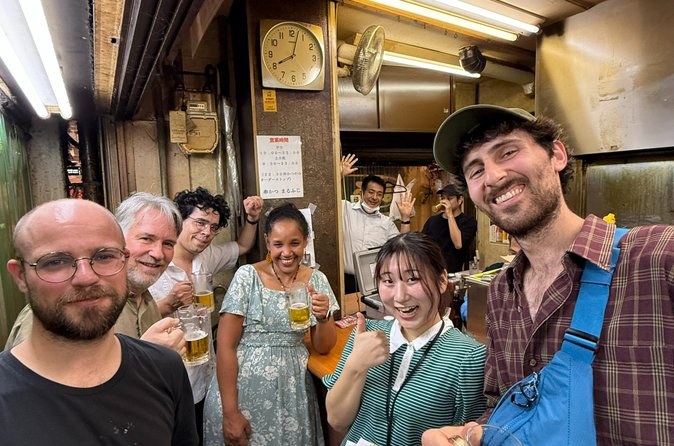
From $30 per person
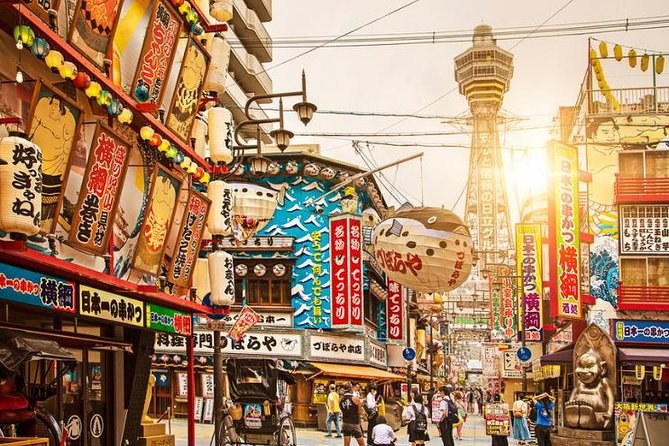
From $69 per person