Osaka Backstreet Nightlife & Street Food Walking Tour
Food includedDrinks includedLive English guide
From $105 per person
Osaka is a one- or two-night stop on most Kansai itineraries, which means the evening has to work first time. This is that evening, planned twice — once for winter, once for summer — because the light here moves by two and a half hours across the year. guided tours of Osaka after dark lists the guided versions.
Sunset in Osaka is 16:47 in early December and 19:15 at the end of June. That is not a detail; it is the difference between a 6pm departure that begins in full darkness and one that begins in daylight and only turns into a night walk during its second stop.
Sunset times published by the National Astronomical Observatory of Japan for Osaka, 2026.
| Month | Sunset | Start the evening at |
|---|---|---|
| January | 17:10 | 18:00 |
| February | 17:41 | 18:30 |
| March | 18:05 | 18:30 |
| April | 18:30 | 19:00 |
| May | 18:54 | 19:00 |
| June | 19:13 | 19:00 |
| July | 19:12 | 19:00 |
| August | 18:47 | 19:00 |
| September | 18:06 | 18:30 |
| October | 17:24 | 18:00 |
| November | 16:54 | 18:00 |
| December | 16:49 | 18:00 |
17:00. Draw cash. Ten to fifteen thousand yen covers anything the night can ask for, and the counters you will end up at do not take cards.
17:30. Arrive at the meeting point. It will be a landmark rather than an address, and if it is anywhere near Namba, give yourself the extra ten minutes.
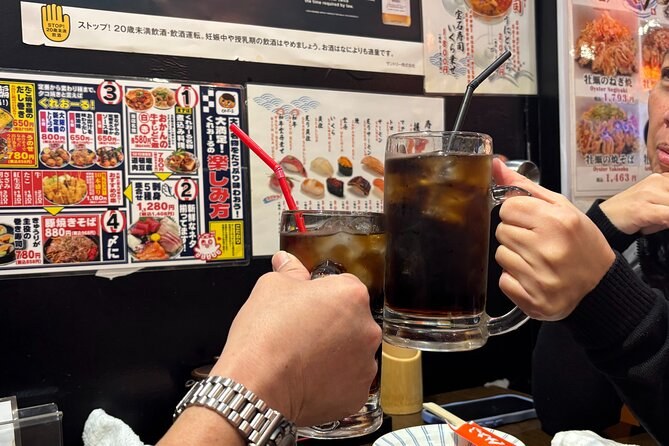
18:00–19:30. The first stretch. On a food evening this is two counters and a walk; on a bar evening it is a walk through Dotonbori and the first room.
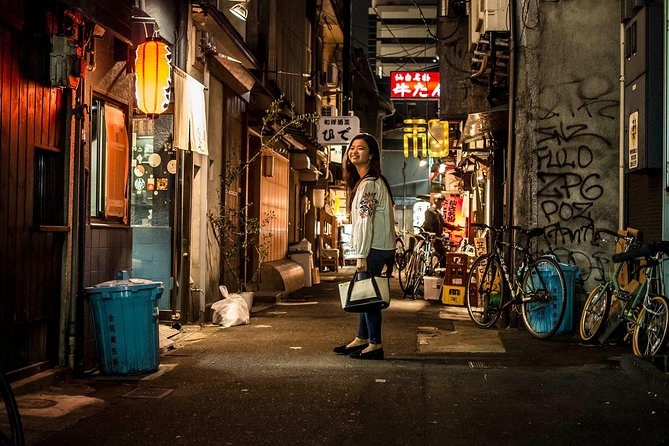
19:30–21:00. The second half, and the part people remember. By now the signs have been lit for four hours and the streets are at their fullest.
21:00. Finish. You are within a few minutes of a station and the metro runs for another three hours.
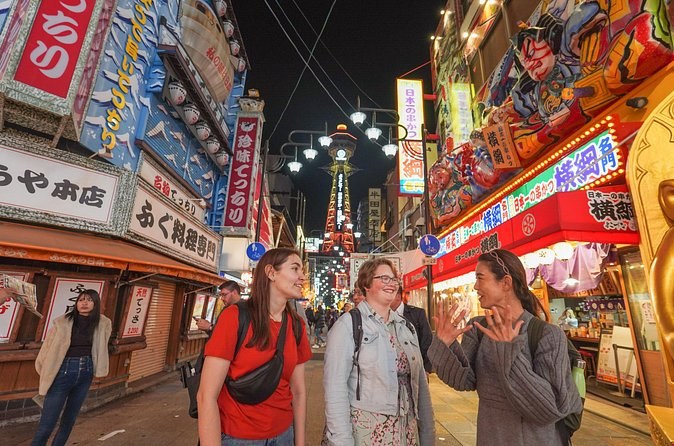
21:15. Walk to the Ebisu Bridge if you are not already there. It is the last free thing on the list and the best-lit.
Everything shifts an hour later and one thing changes in kind: you will start in daylight, so the first stop is about food rather than atmosphere.
18:00. Cash, and water. One operator asks for it explicitly and recommends a hat; August evenings here are humid rather than merely warm.
18:30–19:15. Meet and walk. Sunset lands somewhere in here, and the change is quick once it starts.
19:15–21:30. The rest of the evening, fully dark from the second stop onwards.
21:30. Finish, and consider the Umeda Sky Building if you have energy: it takes its last visitors at 22:00 and it is the best view in the city.
One district properly, or two if they are next to each other. Not three. Every guided evening here runs two to three and a half hours and covers one or two districts, and that is not a limitation of the tours — it is how long the walking takes.
The pairs that work are Dotonbori with Uranamba (two minutes apart), Shinsekai with Dotonbori (four metro stops), and Tenma with Kyobashi (three or four minutes by train). Two evenings do the last of those on purpose.
Namba Station, and walk north to the canal. You will hit the Ebisu Bridge in five minutes, the Glico sign is directly opposite, and Hozenji Yokocho is a hundred metres south of it down a stone lane.
From there the arcades take you back north under cover. That loop is ninety minutes, costs nothing and covers the postcard version of the city. Anything beyond it — the bars, the counters, Tenma — is where a guide starts to earn the fare.
Three dishes carry Osaka’s reputation and they are geographically split, which is convenient for planning.
| Dish | What it is | Where |
|---|---|---|
| Takoyaki | Octopus in batter, turned in a cast-iron plate | Dotonbori and the arcades |
| Okonomiyaki | A savoury pancake, often cooked at your table | Namba, widely |
| Kushikatsu | Skewers, deep fried, one dip and no double dipping | Shinsekai |
| Oden | Slow-simmered winter stew from a shared pot | Standing bars, winter |
| Yakitori | Grilled chicken skewers, counter food | Uranamba, Tenma |
Later than you think, but check it. Osaka Metro runs to around midnight and last trains leave central stations between roughly 11:50pm and just after twelve. A guided evening finishing at 21:30 leaves you two and a half hours of margin.
The exact time differs by line and by station, and Osaka Metro publishes every one of them. Look up the station nearest your hotel before you go out. The visiting page has the link.
Split them by format rather than by district. Night one: a food evening, which gives you the districts, the dishes and enough vocabulary to order for yourself. Night two: a bar evening, which now makes sense because you know what you are looking at.
If you would rather split by geography, do the south on the first night — Dotonbori, Shinsekai, the arcades — and go north to Tenma and Kyobashi on the second. Almost no visitor does the second half, which is the argument for it.
Some people arrive at seven or eight because a train from Kyoto or Tokyo ran late, and the guided departures have already gone. The city is still entirely usable.
Two ticketed things are still open: Tsutenkaku until 21:15 and the Umeda Sky Building until 22:00, and the second is the better of the two. The canal is at its fullest between eight and eleven. Kushikatsu shops in Shinsekai and izakaya everywhere run well past that.
What you lose is the guided part — the small counters and the bars behind unmarked doors, which is exactly the half that is hard alone. If your evening is going to start late, book the tour for the following night rather than trying to squeeze it.
Three rules that hold across the city. Look for a queue of people who are clearly local rather than clearly visiting. Look for a menu on the wall in handwriting rather than a laminated one with photographs. And if a place has an English menu and a person outside encouraging you in, keep walking.
The safe bets by district: takoyaki from any of the stalls on Dotonbori, okonomiyaki around Namba, kushikatsu in Shinsekai, and yakitori at any counter in Uranamba or Tenma. Expect to spend 3,000 to 6,000 yen a head for a good evening of it.
The one thing that will not work is walking into a six-stool counter with no English signage and hoping. That is not rudeness on their part; it is a room with no system for somebody who cannot read the wall.
It matters more than people expect, because Osaka’s night splits north and south. Namba and Shinsaibashi put you inside the southern half: the canal, Uranamba, Sennichimae and the arcades are all walkable, and Shinsekai is four metro stops away.
Umeda puts you at the top of the city, ten minutes from Tenma and close to the Umeda Sky Building, but a twenty-minute metro ride from Dotonbori. Neither is wrong; they simply make different evenings convenient.
If you are staying near Osaka Station or Shin-Osaka, budget the extra twenty minutes each way and book a departure that starts a little later. If you are staying in Kyoto and coming in for the evening, allow an hour each way and take a food evening rather than a bar one, so you are not making a last train decision at eleven.
What to expect covers the practical side in detail, and Osaka Night Tours lists every guided evening with its start time and its meeting point.
From $105 per person
From $107 per person