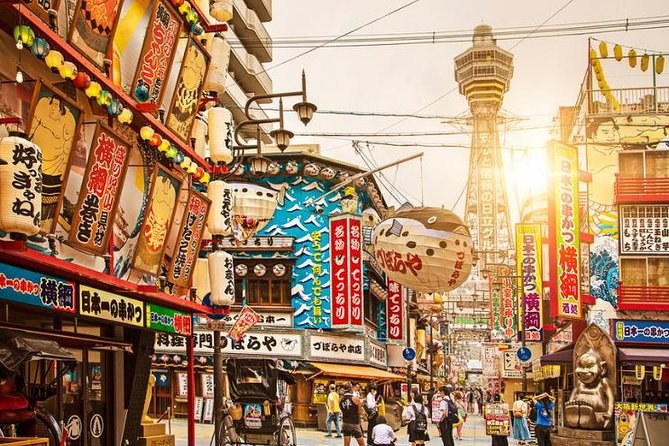
Osaka Food Tour: 15 Delicious Dishes & 3 drinks at 5 Eateries
Food includedDrinks includedLive English guide
From $69 per person
Osaka after dark is one of the easiest cities in Japan to enjoy and one of the hardest to order in. The streets are free, lit and safe. The rooms worth sitting in are six seats wide, cash only, and have no English menu. Everything below is about closing that gap, and Osaka Night ticket prices lists every guided evening that does it for you.
This matters more here than in most cities, because the swing is large. Sunset in Osaka is 16:47 at the start of December and 19:15 at the end of June — two hours and twenty-eight minutes apart. A six o’clock departure is a night walk in one and a daylight one in the other.
Mid-month, published by the National Astronomical Observatory of Japan.
| Month | Sunset |
|---|---|
| January | 17:10 |
| February | 17:41 |
| March | 18:05 |
| April | 18:30 |
| May | 18:54 |
| June | 19:13 |
| July | 19:12 |
| August | 18:47 |
| September | 18:06 |
| October | 17:24 |
| November | 16:54 |
| December | 16:49 |
The practical rule: if you are travelling between November and February, book the earliest departure you can, because you get a full evening of lit streets. Between May and August, the later the better. The weather page has the rest of what changes with the season.
Most of what you came for is a public street, so it is open, free and unticketed. Three things are ticketed and worth the money, and all three are bought on the door.
Osaka Castle is the one worth reading twice. The park never closes and costs nothing; the keep stops admitting at 17:30 and now charges ¥1,200 for an adult, up from ¥600 in April 2025. The attractions page has all of them with their sources.
Nothing, if you want it to. A walk from Namba Station to the Ebisu Bridge, then south into Hozenji Yokocho and back through the arcades, is ninety minutes and free.
Guided, the range is $30 to $135 a head, and the spread is almost entirely about dinner. The cheap end buys a guide and you settle the counters yourself in cash. The top end includes the meal, the drinks and sometimes the train fare. Add the counter bill before you compare them.
Osaka calls its own appetite kuidaore, which translates roughly as eating yourself bankrupt. Three dishes carry the reputation, and they are geographically split.
You can find all three alone. What you cannot easily do alone is get a seat at the counter with the queue outside it, because that is the one with no English menu.
Osaka Metro runs to roughly midnight, with last trains from central stations between about 11:50pm and just after twelve. Guided evenings finish between 8:30pm and 9:30pm, so there is real margin. The exact time varies by line, and Osaka Metro publishes every station’s first and last train on its own site.
If you are staying near Namba or Umeda, you are within walking distance of most of this anyway. The map page shows how the districts sit against each other.
Ten meeting points across seven districts, and none of them is a street address you can drop into a phone and trust. They are landmarks: a convenience store outside a station exit, a coffee shop inside a park, a stone monument on the canal promenade, and one shop in an underground shopping arcade below the roads.
Namba is where most of them cluster, and Namba is not one station. Osaka Metro, Nankai and JR all have entrances under different names, and Exit 14 of one is a long way from Exit 23B of another. Allow ten minutes more than the map suggests, and read the operator’s own instruction the night before rather than on the way.
The two outliers are worth knowing about. Dobutsuen-mae, for the Shinsekai food evenings, is fifteen minutes south of Namba on the Midosuji line. Osakajokoen, for the ghost walk, is twenty minutes east with a change. The map page lists every one with its line and its landmark.
Japan is less card-friendly than its reputation suggests, and the rooms these evenings use are the least card-friendly part of it. A six-stool counter with a hand-written menu has no terminal and no interest in getting one.
On a food evening you barely need money at all, because the meal and the first drink at each stop are already paid for. On a bar evening the whole bill lands at the end and is split evenly across the table. Two operators publish the number, which is more useful than most listings manage: about 7,000 yen a head on one, 8,000 to 10,000 on another.
Draw 10,000 to 15,000 yen before you go out. Airport ATMs and the machines in convenience stores both take foreign cards; the bar you finish in will not.
Further ahead than you would think. One operator publishes an average booking lead of 53 days on its busiest evening, and most departures cap at six, seven, eight or ten travellers. April, May, October and November fill first.
Every evening listed refunds in full at 24 hours’ notice, and several let you reserve now and pay later, so booking early costs you nothing. The FAQs cover the rest.
If you want to choose between the formats rather than the individual departures, the options page puts them side by side, and what to expect covers the practical side in detail. Osaka Night Tours has every evening with its price and its cap.
From $69 per person
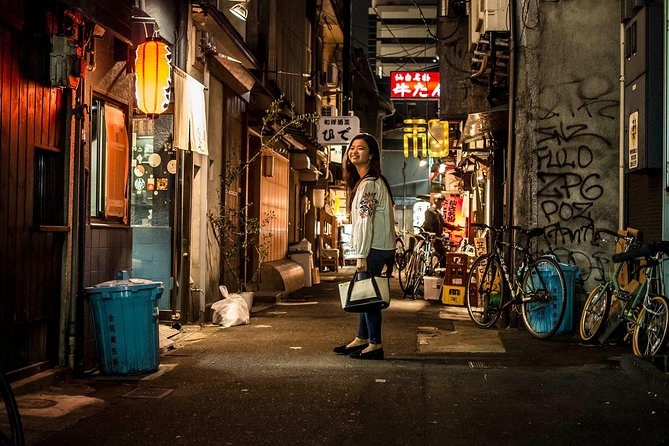
From $105 per person
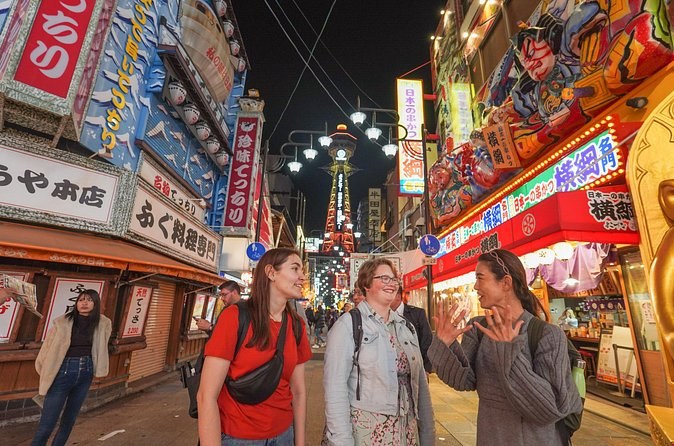
From $107 per person